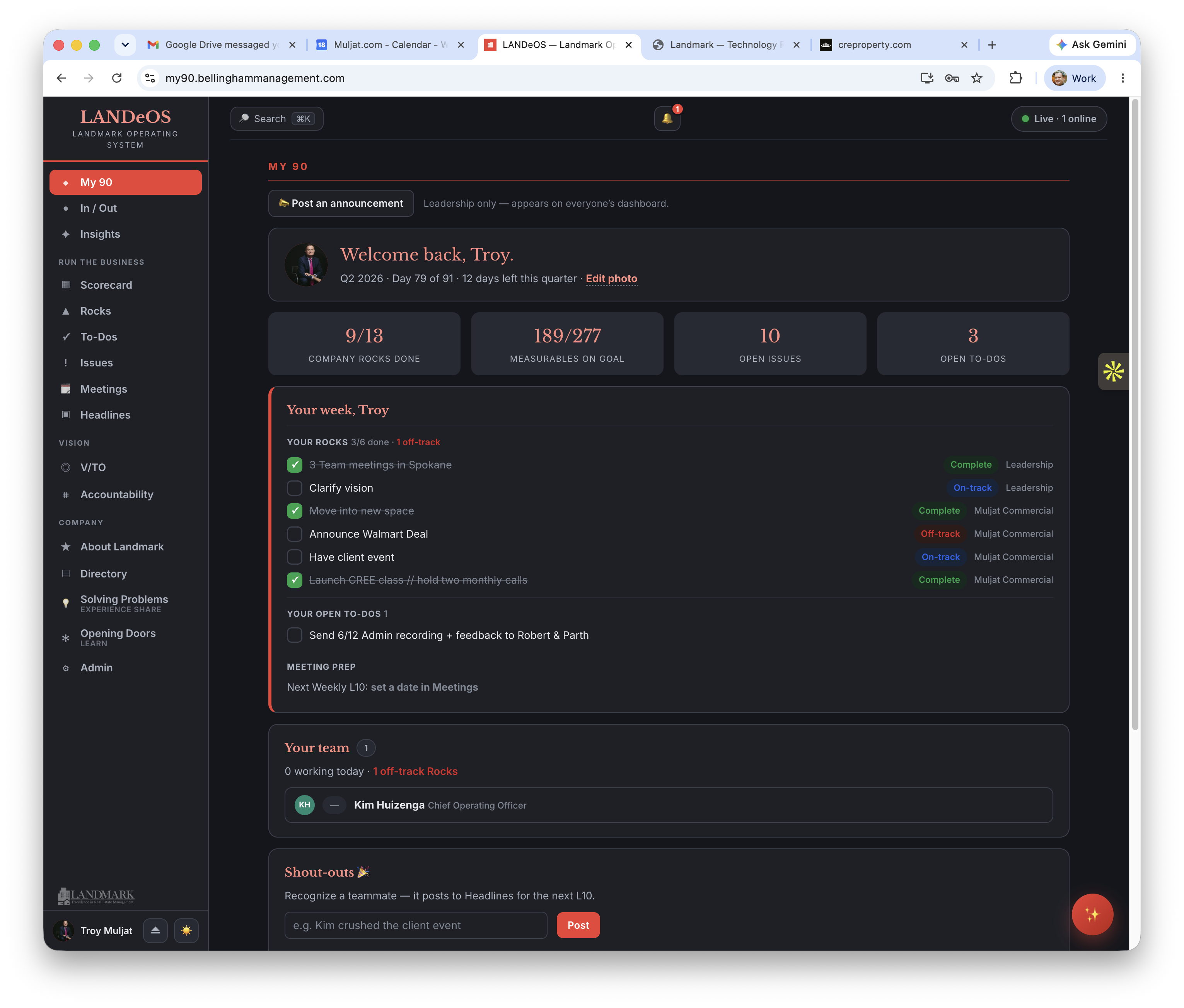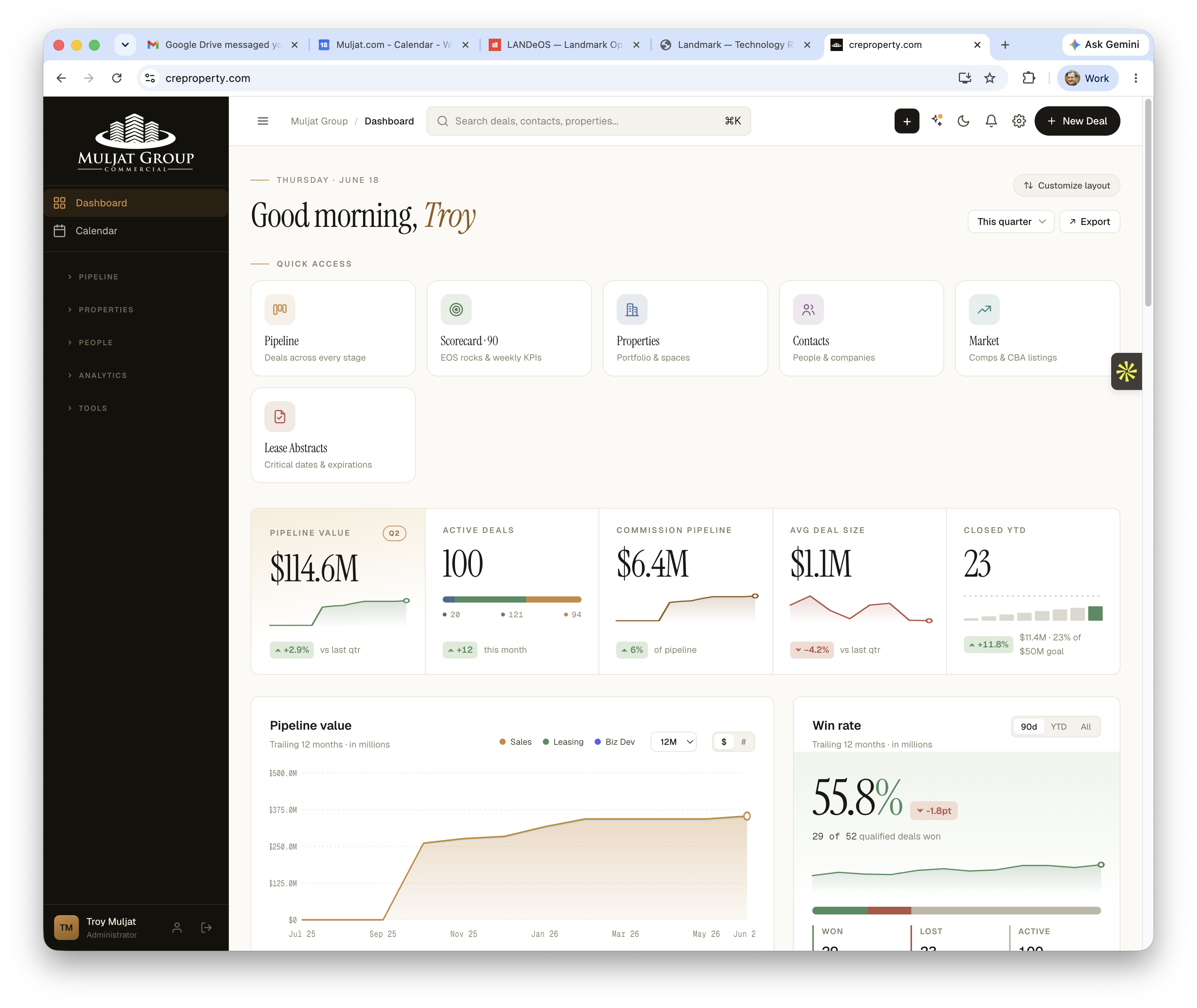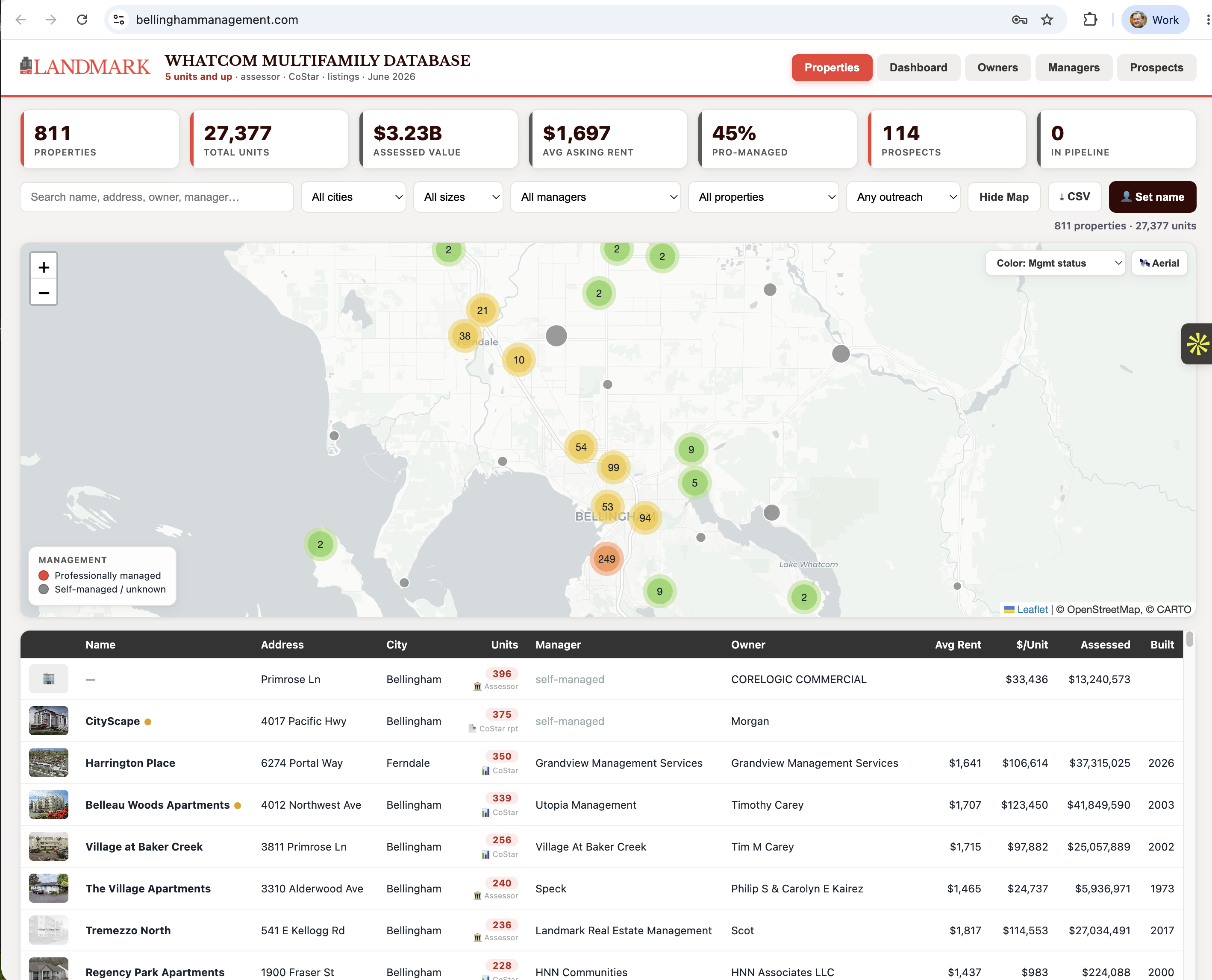
Live system — switch to demo
Technology Review

Confidential.

This presentation is provided in connection with a private transaction review. Enter the access code you were given to continue.
Incorrect code — try again.
Confidential · Not for distribution
CONFIDENTIAL — ACQUISITION REVIEW
Technology & operations review
Property management at scale — and the technology layer we built to run it.
SubjectThe Landmark Platform WithTroy Muljat · CEO StatusConfidential — Working Session
Who we are — core purpose

Opening doors. Building wealth.

That's our core purpose — not a tagline, a promise. Landmark Real Estate Management, Bellingham, Washington: ~4,000 doors, ~10,000 residents, 60+ team members. Spokane opens in 2026, Boise and Vancouver follow — on the way to 20,000 units across six markets by 2035.

Simplify·Standardize·Scale
01

Maintain Accountability

We do what we say we'll do. Every time.

02

Problem Solvers

We don't wait for an answer. We go find one.

03

Drive Change

We lean in where others see disruption.

04

Serve Others First

Owners, residents, teammates — help first.

05

Do What's Right

Even when it's hard. Even when no one's watching.

We run on EOS — rocks, scorecards, L10s. The discipline is "simplify before you multiply" — and when no software on the shelf could deliver that simplicity, we built our own.
What you're actually buying

Landmark is two assets
in one wrapper.

The first is a property management operation you can value on cash flow. The second is the technology layer running underneath it — an agentic back office, built on the live book, that does the repetitive operational work. The second one is why this conversation is different.

Asset 01 — the operating business

Landmark Real Estate Management

  • 4,100 residential units · 920K SF commercial
  • Established brand, recurring management revenue
  • The live portfolio the platform was built on
Asset 02 — the technology layer

ChiefAIO — agentic back office

  • AI agents that code bills, reconcile, and draft statements
  • Money-safe, audited, human-in-the-loop
  • In production today — not a roadmap
The market window

AI in property management just
crossed the chasm. The window is open.

78%
Of operators say they've already lost business to AI-enabled competitors
34%
Of property managers using AI — up from 21% in a single year
18–36mo
The window before incumbents close the agentic gap

Operators that own this capability now set the cost structure the rest of the market has to chase. Landmark already owns it.

Sources: EliseAI, The 2025 State of AI in Multifamily (280 operator executives) · AppFolio 2025 Property Management Benchmark Report (2,000+ PMs)
Where the field is — and where it isn't

Front-office AI is a crowded shelf.
The money-safe back office is empty.

The incumbents — AppFolio, Buildium, Yardi — were architected pre-AI and bolt agents on, gated to premium tiers. The AI-native challengers — EliseAI, Funnel — do leasing chat and CRM, and none of them touch money. An AI that codes a bill is a weekend hack. An AI that cannot double-pay, cannot skip a deposit rule, and logs every decision to a seven-year standard is a year of architecture. We did that year.

Crowded — front office

Leasing chat, CRM, scheduling

  • EliseAI, Funnel, Knock, ELI+ — billions in valuation
  • All sit on top of someone else's ledger
  • None of them move a dollar
Empty — the seam we hold

Agentic back office

  • Bill coding, reconciliation, owner statements, deposits
  • Money-safe, audited, human-gated by design
  • Running in production on a real book today
Why we built it — part one

Before we built anything,
we audited ourselves.

March 2026: a two-day, on-site operational audit of Landmark's own shop — twelve staff interviews from the front desk to the CFO, every system in the stack reviewed, every workflow walked end to end. Not a vendor's pitch deck — a hard look at our own operation.

157
Distinct findings documented across the operation
$411K/yr
Software spend across 16+ tools — before payroll touches a single task
<50%
Of the core PMS's features actually used — confirmed by multiple staff
$445K–$742K in annual savings identified — nearly all of it locked behind what the tools couldn't do.
Why we built it — part two

Every tool we bought hit
the same ceiling.

Read-onlyThe workflow layer couldn't write back. It read the PMS but every action had to be re-entered by hand — staff logging the same data three to five times. $72K a year for what leadership called "zero value, actually negative value."
No edge casesEvery exception broke the automation. Backdated entries, lease breaks, large group applications — each one fell back to a human and a spreadsheet. The result: five shadow spreadsheets, three CRMs, 500–600 receipts hand-keyed every month.
Bolt-on AIThe incumbents' AI was bolted on, gated, and not trusted. Premium-tier paywalls on pre-AI architecture — the people doing the work turned it off.
The verdictThe audit's conclusion: growth to 16,000 units on the current stack is not feasible. No amount of additional subscriptions fixes that.
So we stopped renting other people's software and built the layer ourselves. That platform is ChiefAIO — and the audit is its product spec.
What we built

Software shaped like our
seven-step management model.

We didn't buy a system and bend our process around it. We built the system around the way Landmark already manages a door — seven steps, digital employees working every one.

01

Market

Vacancies, showings, walk-in queue.

02

Qualify

AI receptionist, screening, Apps AI.

03

Onboard

Leasing, deposits, inspections.

04

Collect

Financials, bills/AP, reconciliation.

Proven first
05

Maintain

AI dispatcher, follow-ups, work orders.

06

Communicate

Owners, reports, scorecards.

07

Transition

Renewals, move-ins and move-outs.

Built and running on the live portfolio today — not a prototype, not a roadmap.
Proof — already live

This runs today on Landmark's
real book of business.

343K+
AP bills under management
194K
Invoice PDFs captured & processed
Live
Bills · CRM · work orders · reconciliation

Built end-to-end on Landmark — a working property-management operation and Troy's own portfolio. The platform is real, the data is real, the agents run against it. In two minutes you'll watch it work.

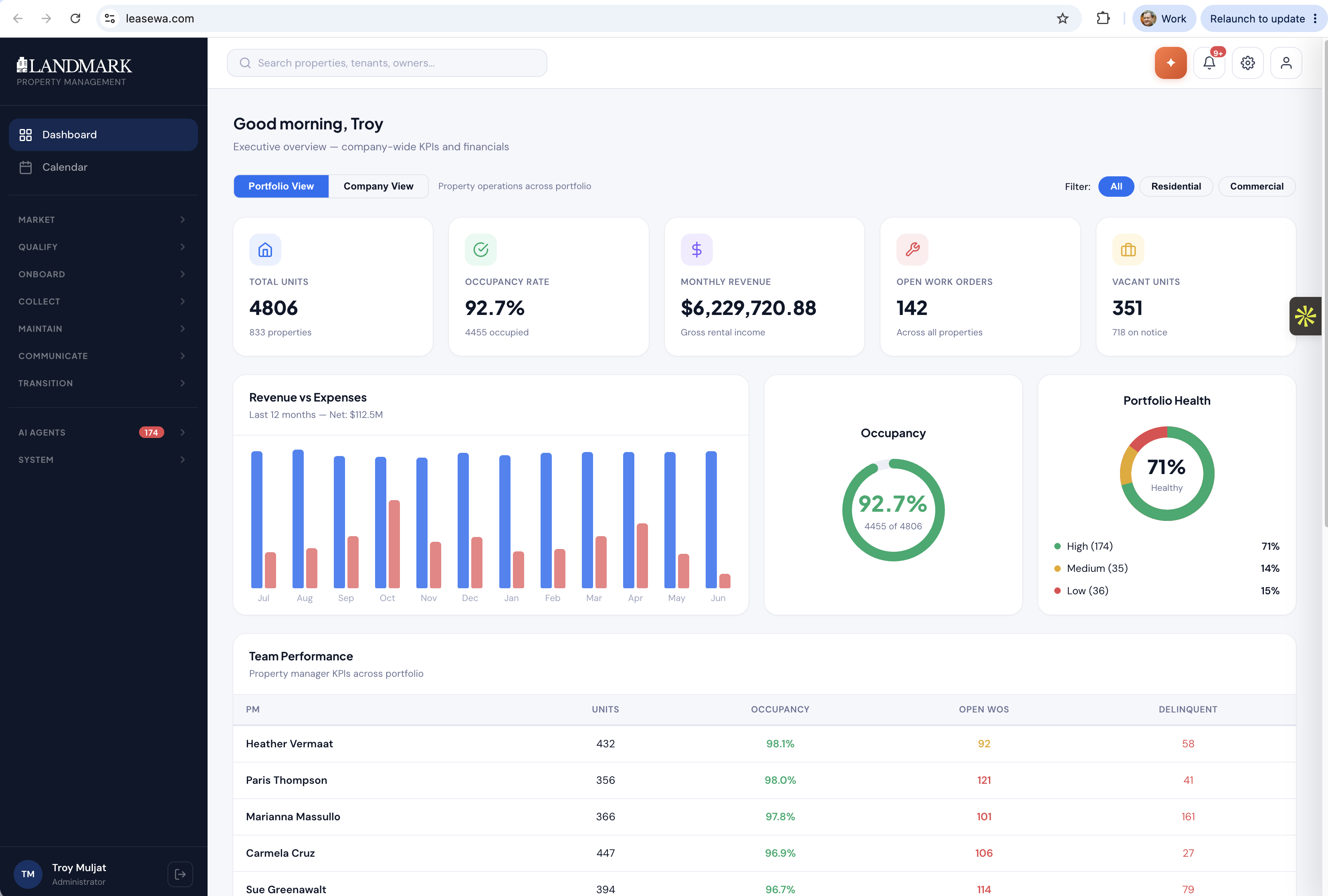
The product — beta, live at leasewa.com

Not a mockup. The live beta.

leasewa.com
Landmark platform dashboard — executive overview with portfolio KPIs
174
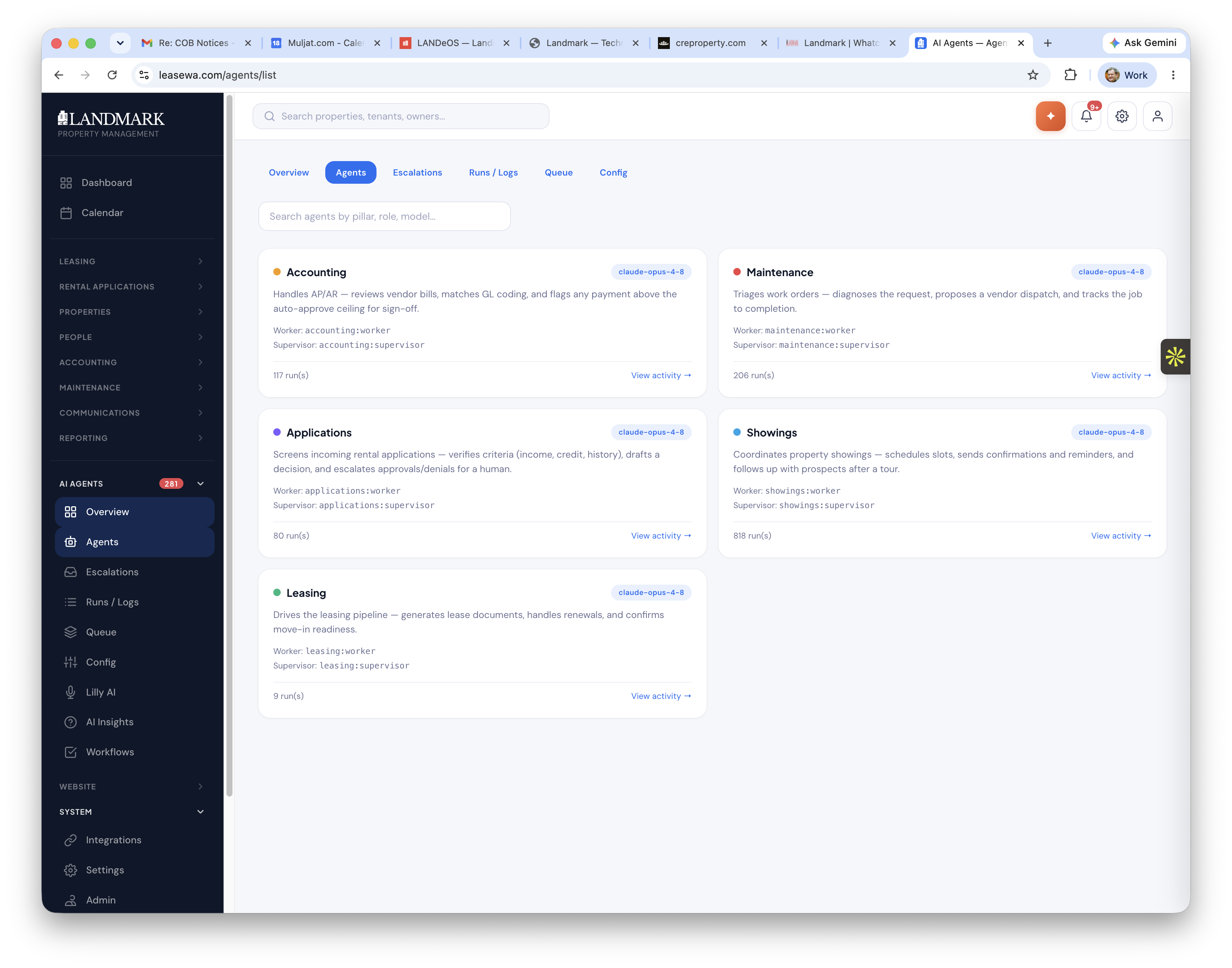
AI agents working in the system today
4,806
Units in the platform — the live book, not seed data
7 steps
The navigation is our management model — market to transition
Executive KPIs · scorecards · AI receptionist · AI dispatcher · bills & AP — one login instead of sixteen tools.
Live demo

Don't take the slide's word.
Watch it do the work.

What you're about to see — three moments
01 — IT WORKS

A real bill, coded live

Pull an actual invoice from the live system. The agent reads it, codes the GL, proposes the action — on real data, not a sandbox.

02 — IT'S SAFE

The guardrail stops it

We trigger an unsafe action on purpose. Watch the deterministic gate block the commit and route it to a human. This is the moment that matters.

03 — IT'S PROVABLE

The full audit trail

Open the transcript. Who, what, why, when — every decision logged, replayable, to the standard your diligence team will ask about.

[ Presenter: switch to leasewa.com now. Return here when done. ]
How the work gets done

Agents that do the work
not a chatbot bolted onto a PMS.

WorkerDoes the task. Reads the data and works out the answer — the GL code, the payment match, the disposition — then proposes it. Models are tiered so cost stays flat at volume: lightweight models triage, the working model does the task, the most capable model is reserved for high-stakes review.
SupervisorReviews the work. A second pass for coherence and completeness — catches what doesn't follow from the data, writes the audit note, decides what a person should see. The hard safety guarantees don't rest on it; those live in code.
HumanIn the loop by configuration. Dollar limits, new vendors, unmapped accounts route to the operations team. Nothing irreversible commits without a person.
The routine runs on its own. Anything irreversible or material is gated — that's what makes it deployable at portfolio scale.
Why this runs in production with real money

The safety isn't the model being smart.
It's the model being unable to skip the check.

Every money-moving or irreversible action passes through a deterministic gate before it commits — code your engineers and counsel can read, that no model, however confident, can argue its way around.

Live readRe-checks reality at the moment of commit. Microseconds before any write, the system re-reads the live record. A bill paid out-of-band five minutes ago cannot be paid twice.
Hard rulesDeterministic, version-controlled, lawyer-reviewable. Deposit returns, new vendors, unmapped accounts, over-threshold amounts always stop. Code — not a prompt the model can be talked out of.
Human gateEvery irreversible action needs a person. No confidence score overrides the human approval.
Full auditWho, what, why, when — retained seven years. Every decision with the agent's reasoning verbatim, replayable, to the HUD standard.
Architecture

Built once. Runs on top of
whatever the portfolio runs.

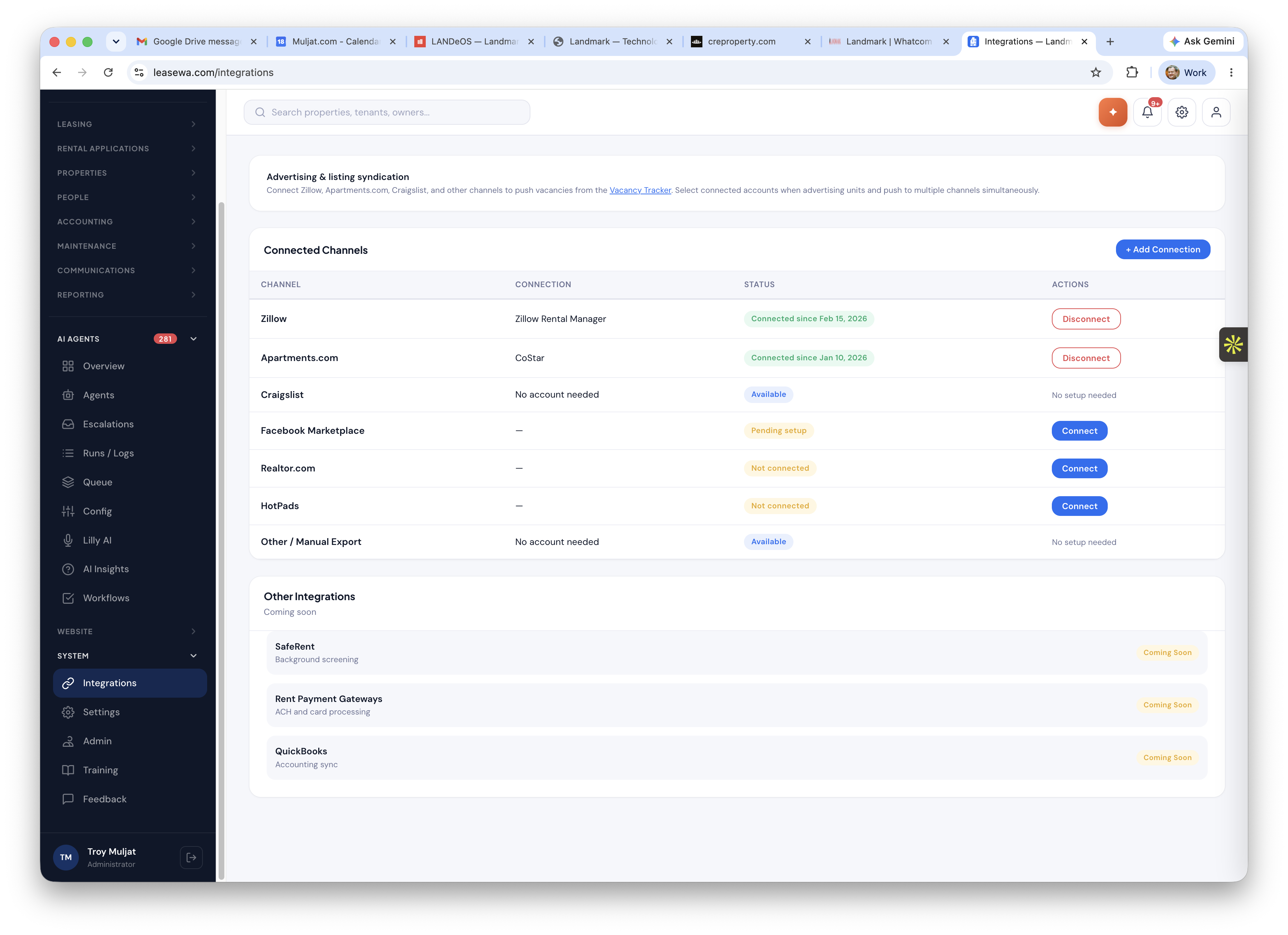
A normalized adapter layer means the agents don't care what the underlying PM system is. Acquire a book on AppFolio, Buildium, or Yardi — the same agent layer drops on top without rebuilding anything.

Agent layer — the 5 pillarsPMS-agnostic by design
▲ ▼
Normalized data model + adaptersone common shape
▲ ▼
AppFolio — live today Next acquired book — scoped adapter Buildium Yardi
AppFolio runs in production now. Each new adapter is dedicated, scoped work — which is what makes this a roll-up engine, not just a tool.
What the tech layer is worth to you

Three ways the platform
pays you back.

01 — In the P&L

Margin engine

The back office absorbs doors without adding headcount. Cost per door falls as the portfolio grows — the inverse of every traditional PM cost curve.

Compounds with scale
02 — In the strategy

Roll-up platform

The adapter architecture drops the same agent layer onto any acquired book, whatever PMS it runs. Buy doors, plug them in, take out the back-office cost — repeatably.

Built for M&A
03 — On its own

Standalone asset

The market prices AI-native PM tech on venture multiples — EliseAI at $2.2B, Entrata at $4.3B, AppFolio near $6B — and none of them hold the money-safe back office. The platform licenses beyond Landmark.

Optionality
The doors are valued on cash flow. The platform is valued on what the market pays for AI-native PM technology — and the back-office seam is still unclaimed.
Next step
You're not just
buying doors.

A working diligence session: the live system, the audit trail, the cost-per-door data, and the architecture walkthrough with the team that built it.

Troy Muljat  ·  Landmark Real Estate Management visitlandmark.com  ·  ChiefAIO, the agent platform inside Landmark
01 / 16
← / → to navigate